Quantum computing for lawyers
and anyone who’s not sure what “quantum” means
Last week I had lunch with a lawyer friend:
– So tell me, what’s this quantum thing about?
– You mean quantum computing?
– That scary thing in the news.
– Quantum computing.
– So explain it to me.
I then remained silent for thirty seconds, as I always do when someone non-technical asks me this. I looked for an angle that wouldn’t insult her intelligence or distort reality, and without the lazy analogies you hear on YouTube.
My friend is brilliant, but knows nothing of quantum physics or algebra. Instead of jumping into technicalities, I found that what works well is saying what QC is not, starting from the familiar misconceptions. But before that, I must clarify the meaning of “quantum” and “computing.”
Trigger warning: To physicists and quantum engineers: there may be wince-worthy simplifications. If you catch anything blatantly wrong or misleading, call me out and I’ll fix it.
Disclaimer: Not all lawyers are clueless about quantum computing. Another lawyer friend, after seeing a draft of this post, suggested I start with: “The first thing it’s not is ‘in existence.’” I happily complied.
Quantum
In quantum computing, “quantum” refers to quantum mechanics a.k.a. quantum physics, which explains how small particles behave: photons, electrons, and so on. The rules down there are nothing like those that govern planets, rocks, and basketballs; gravity matters very little, for example. Instead, weird and counterintuitive rules apply, like:
Particle–wave duality: A quantum object behaves both like a particle and a wave, depending on how you look at it. As a particle, it shows up at a specific place; as a wave, its position is not pre-determined but described by probabilities. And waves can add up or cancel out, like sound waves in your noise-cancelling earphones—that’s interference.
Entanglement: A quantum state can involve several particles, for example multiple ions. Observing one particle can tell you what you’ll find when observing the others, even if they are light-years apart.
Randomness: Colloquially, we call events random when they’re hard to predict, even though they follow deterministic (that is, non-random) laws, like a coin toss does. Quantum mechanics involves genuine, non-deterministic randomness.
Terminology footnote
Physicists borrowed the word “quantum” from Latin, plural “quanta,” to mean a discrete amount of energy, time, matter, or other physical concept. In physics, a quantum is the smallest relevant unit within a given theory. A common misunderstanding is that quanta are necessarily indivisible*, whereas they’re not always:
Photons are (essentially) indivisible energy quanta in the context of electromagnetic fields. However,
The nucleus of an atom can be treated as a quantum in the context of nuclear physics, even though it’s made of smaller parts: protons and neutrons, themselves made of quarks (indivisible).
*A particle is indivisible if it’s not [known to be] made of other parts. The known-to-be, generally accepted understanding is called the Standard Model of Particle Physics, or just the Standard Model.
Computing
Computing is the business of turning the input of a program into its output. In today’s computers, input and output are bits (ones and zeros), but in principle they can be described in many other ways, like bigger numbers or other symbols, or dog barking.
A program describes the operations the computer applies to the input. It’s usually in a human-readable language like the Python or Rust programming languages, which another program—an interpreter or a compiler—translates into computer-level operations: arithmetic operations (addition, multiplication, etc.), logical operations (AND, OR, etc.), or memory manipulation (data copy, erasure, etc.).
Quantum computing (theory)
Physicists came up with quantum computing because they were stuck: classical computers weren’t powerful enough to simulate the behavior of small particles in order to test physics theories. Instead of simulating Nature’s fabric with electronic computers, they figured they could work with the real stuff they want to simulate, directly obeying the very laws they’d have to simulate with transistors.
QC was first imagined by Richard Feynman in the papers Simulating physics with computers (1982) and Quantum mechanical computers (1985). Rather than manipulating bits with electronic circuits and transistors like classical computers do, QC manipulates quantum states. This means that
Input and output are encoded as quantum states—remember, the things made of quantum objects, which behave “randomly” and interfere with each other because they’re kind of waves even if they’re called particles.
Programs transform quantum states, rather than bits or numbers. These operations are totally different from your CPU’s addition or multiplication: simplifying really a lot, quantum operations—quantum gates—change the probabilities** underlying quantum states; they change the level of uncertainty, they may turn uncertainty into certainty, or the other way. If you wonder what this has to do with computing, worry not.
On paper, a quantum computing program looks like a circuit: objects connected by wires to quantum gates until a final state from which you observe the output, not unlike an electronic circuit:
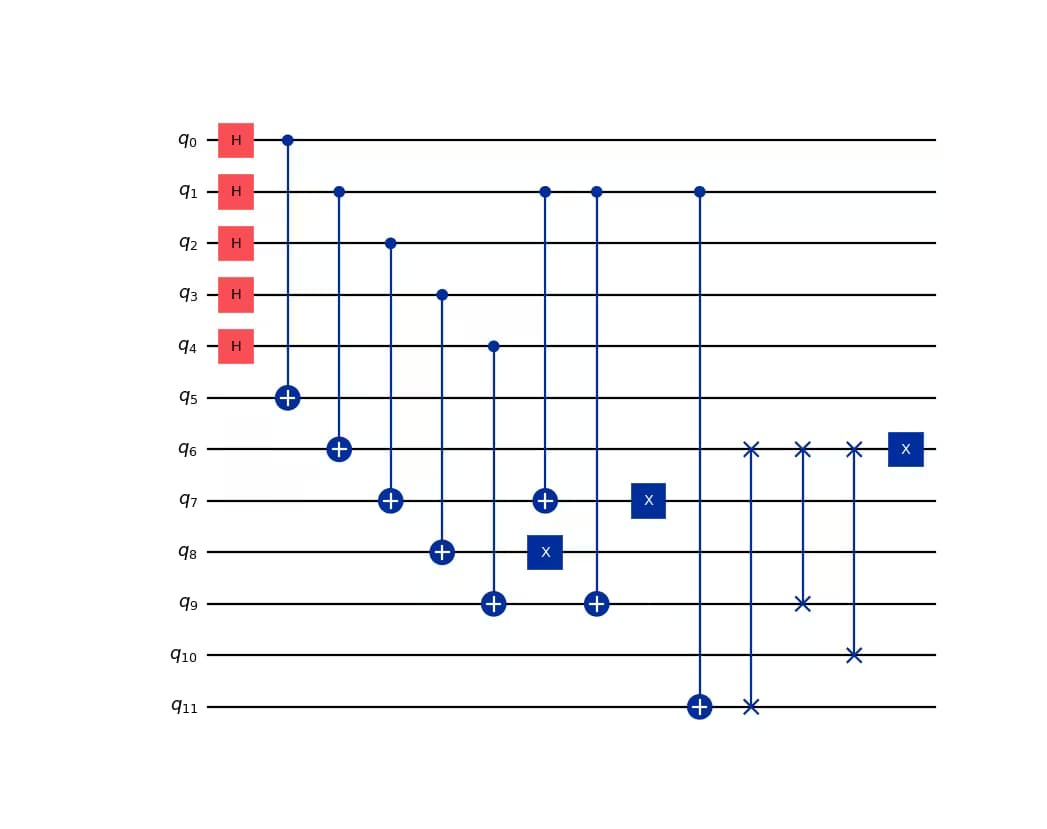
(Image courtesy of IBM.)
**A quantum state’s probabilities aren't the ones you’re used to, like a 50% chance, and generally a decimal number between zero and one. Quantum probabilities are called amplitudes, and are complex numbers (of the form a+bi, where i is the imaginary unit), and can be negative.
Quantum computers (practice)
As previously stated, (useful) quantum computers do not exist yet.
Building and running a quantum computer is way harder than building a microprocessor like the one in your phone. You’re not doing electronics, you’re doing physics. You don’t deal with bits represented as transistors (electronic components) but with quantum bits (qubits) materialized by literally the smallest particles in the Universe. Because they’re minuscule and brittle,
Qubits are extremely hard to create, set in the state you want, manipulate, and get to interact with each other. I won’t elaborate on what “hard” entails, but as you imagine it’s about challenges in terms of science, engineering, logistics, equipment, lab environment, raw material, etc.
Qubits are highly sensitive to their environment: heat, electromagnetic fields, acoustic vibrations, and so on. You need to reduce the temperature to close the the minimal possible (zero Kelvin) and implement quantum error-correction techniques to keep the system stable and error-tolerant.
Several companies*** try to build quantum computers, but after decades of research and billions invested there are only tiny prototypes that—despite what the websites and marketing material and press releases say—are of no practical use whatsoever.
Let me emphasize: None of the current quantum computers prototypes by IBM, Google, or any other company is superior to a modern classical computer, for any reasonable definition of “superior.”
Now tet me do an admittedly unfair and misleading, but not entirely pointless comparison:
A modern laptop can often store a terabyte of data (around 8000 billions of bits) and has a working memory of dozens of gigabytes (billions of bits). Its microprocessor can run computations lasting days, weeks, and more long as it’s kept powered.
Today’s best quantum computer prototypes are limited with respect to:
Qubits number: Around a thousand qubits, of which only a handful can serve to actually compute, because of the…
Error rate: The higher, the more qubits you need to correct errors, with quantum error-correcting codes.
Coherence time: Quantum computers remain stable (and thus usable) only for a time ranging from microseconds to seconds.
Different QC technologies make different trade-offs between those three dimensions, but none currently comes close to satisfying all three.
***None of today’s quantum-computing companies are profitable. When they have revenue at all, it mostly comes from research funding and partnership grants (SPAC-listed QC companies have public quarterly reports.) And don’t be fooled by D-Wave, the self-proclaimed “world’s leading quantum computing company:” what they build isn’t a quantum computer in the standard, gate-based sense, but a machine that happens to involve certain quantum-mechanical effects. D-Wave’s systems are inherently incapable of the kind of quantum speed-ups that I discuss later.
What QC is not
The word “quantum” sounds cool and scientific and mysterious, which is precisely why it’s overused in pop culture and advertizing to suggest some science-backed miraculous technology, from dishwasher tablets to cosmetics. Because quantum computing is actually quantum and poorly understood, it’s a bonanza for hyperbolic and grotesque claims. Even otherwise respectable companies lower themselves to clickbaity statements, amplified and distorted by the content generation industry: Google*** alluded that its QC research results supported the many-worlds interpretation (a.k.a. “multiverse”) of quantum mechanics, while Microsoft claimed to have created a “new type of matter.”
More subtle—and arguably more irritating, and dangerous—are the falsehoods that aren’t outright nonsense. These are the intellectually tempting, audience-pleasing distortions plaguing news sites and YouTube videos, often spread in good faith by experts from adjacent fields. Let me highlight the most common ones.
****Google’s QC unit is branded “Quantum AI,” even though AI is largely orthogonal to QC and they don’t do more “AI” than other QC companies. QCs could run AI models and in theory speed up some subroutines, but the same can be said of spreadsheet macros and search-engines algorithms. (To be fair, some companies go further and claim they do quantum AI when they do neither.)
Myth 1: Free parallel computing
A quantum bit can be seen as (oversimplification warning) being “1 and 0 simultaneously,” in the sense that observing it yields 0 or 1 according to some (quantum) probability parameters. This at-the-same-time-ish state is called superposition.
Wait, if a qubit can be in many states at once, why not create a state that represents all possible solutions to a problem and run the computation once to let the quantum computer find the one that works? We could try all passwords simultaneously and select the correct one at the end!
It doesn’t work that way. Not even close.
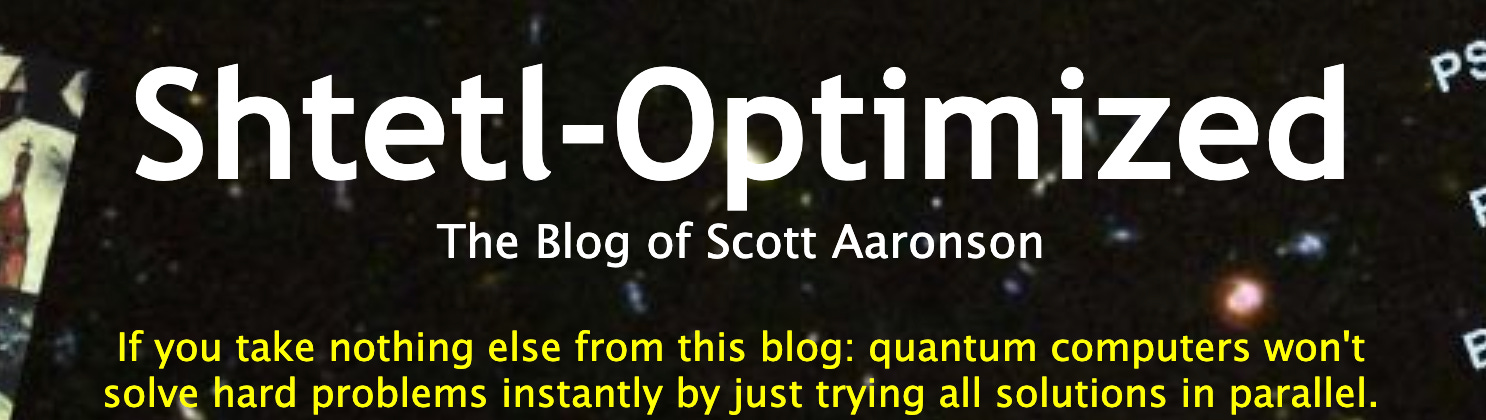
This misconception is so common that Scott Aaronson (among the greatest QC researchers and bloggers) added it to his blog’s banner:
Myth 2: Ultra-fast computers
A QC’s power (we’ll get to it) has nothing to do with speed in the usual sense of velocity. QCs are not classical computers doing the same operations orders of magnitude faster. In fact, if you count raw operations per second, a quantum computer would almost certainly be slower than a classical one.
Myth 3: “Cracking” all cryptography
A corollary of Myth 1: Many cryptographic systems rely on a secret key. Take data encryption, as used to encrypt a database: anyone who knows the key (and has access to the encrypted data) can decrypt it and recover clear text data. Could a quantum computer “crack” such encryption by trying all possible keys at once? No. QC can’t improve on bruteforce, save for a mostly theoretical speed-up.
However, there’s another class of cryptography that quantum computers could break:
Why all the fuss about QC then?
At last, let’s address my friend’s concern:
Why does QC matter for cybersecurity?
Why has U.S. Federal agency NIST standardized a new type of public-key cryptography that is “post-quantum”? And why has it retired the RSA and elliptic curve-based cryptosystems?
Why are cryptocurrency users worried? (And why quantum computers will not steal your bitcoins, even if they can?)
Quantum speed-up
By exploiting superposition, interference, and entanglement, quantum computers could solve certain mathematical problems far faster than any known classical computer; again, not by running the same instructions faster, but by doing (quantum) things that non-quantum computers can’t do.
This is called quantum speed-up. And in some very specific cases, problems that would take classical computers millions of years could, in principle, be solved in days or hours on a sufficiently large QC.
(For a list of quantum algorithms offering quantum speed-ups, check the Quantum zoo.)
Unmultiplying numbers
Most encrypted communications, from WhatsApp discussions to the HTTPS connection to this blog, use public-key cryptography, whose security relies on the difficulty of deceptively simple math problems. One such problem is factorization, or “unmultiplication”: any computer can easily multiply numbers, even very large ones. But they can’t do the reverse operation:
For example, my computer can multiply
40160895852844009921030582458177023751149608603560122736811850395290758101622602227312993008663060573128309806075822160041568801528700271189810757373385118277329108717034617301346931111565786388668586110756276252344613018958475585818678689475264694034888916262136204857616135787294991955010950534715362928961
with
167490607764457115789922096379820718444546728581554589725893099248994268739022303883547106856890629039527872559871857553049463569835676624582299213536348554005121105980941986448170586253727274865993644246974524181147667338383488542450160330541384660724752104687618042059153685486425499029405656789170161284103
and obtain
6726572854757908509192009735316226908350181862868328529931455243588748157623532254497231332747122156614053064156389626106224601390887852274333723141725274232300258425373923736794992336313639711325862458921610845776982386791554679218228917337362619041703342861211862884349013870563321829893198881132168561777205652311559741549923492808959528563944472756679353515749423685198959573829938226017454631095212636707498919070513249730513598379520705705891364183849743691218116470125737479401662245891972047284236561716637900527887566791393045934340156835783212647076267119945090108260675835377686382014735001822686927606983
Given this number, however, no computer can recover its two factors. But a quantum computer could, using Shor’s quantum algorithm. And this would literally break most internet communications.
When?
In theory, given enough time, research, engineering effort, and funding, it should be possible to build a quantum computer that’s large and reliable enough to run Shor’s algorithm and break the public-key cryptography used in practice. We simply don’t know when or even whether this will ever happen.
Many quantum computing companies will tell you “five to ten years.” I don’t expect to see such a machine in my lifetime (though I’d be happy to be proven wrong.) I’m not dismissing the risk, just weighing the evidence the way a lawyer would.
Featured image: Better Call Saul.
Simple binary computing sequentially takes command data from memory and then performs the logical operations coded in the command data. The https://en.wikipedia.org/wiki/No-cloning_theorem) rules out this approach for quantum information.
The standard approach for quantum computing is as a flow of multiple qubits through a sequence of quantum gates.
In this model, a binary computer is used to control the selection of quantum gates and the initial input to the quantum pipeline.
While there would be no performance improvement obtained, computing in this way with only traditional computing elements would be by providing an auxillary box to which the programmer would send binary words and the box would process the binary words to produce logical outputs.
While this model would make no sense using traditional binary bits, the logic of qubits makes this format attractive for quantum computing because of the unique talent for quantum logic to process entangled information. Using quantum logic is like finding needles in a haystack without checking every straw.
A bit of history: 1st: ‘computers’ were people trained to solve complex problems (see movie “hidden figures”) 2nd: computers used to be big and expensive. They needed specially trained people to operate them. Then came mini-computers which took up less space, but had limited function and were used to control machines (look up Naked Mini). Then Intel decided rather than use a complex custom circuit to use a programmable system to, if my memory server, run a Mainframe disk drive. A couple of hobbyists wrote an article for Popular Electronics using that processor and a bunch of 100 pin connectors (because they found those on sale for the 50 or so kits they thought they would sell) They got a thousand orders within a week and the hobby computer craze started. A couple of kids in California though they could sell pre-built hobby computers for those who didn’t want to solder their own and allowed others to write programs for it (you may have heard of that company…Apple).
Up until this point if you wanted more than one person to have access to a computer (or wait in line for hours to access the mainframe, you had to connect using a simple keyboard and monitor setup.
While we now can have in our hands computers which are far more capable than the old mainframes there are somethings that your desktop can’t provide: reliability and scale. A computer center (whether its company owned, shared or a cloud center) has is redundant communications links, 24/7 power with regularly tested backups and the reliable hot swappable components. On a mainframe you can replace processors, memory , mass storage without shutting anything down. On a smaller scale, what looks like a tower computer, if its a server will have redundant power supplies, error correcting memory and mass storage which can support disk failure with replacement disk able to be swapped in and the system restored in the background. What happens when say the redundancy fails, major airlines have to stand down operations for several days. What happens if the bank’’s data center fails, all their ATMs stop issuing money.