The Border Trilogy
The Eras Tour, Cormac McCarthy (4/6)
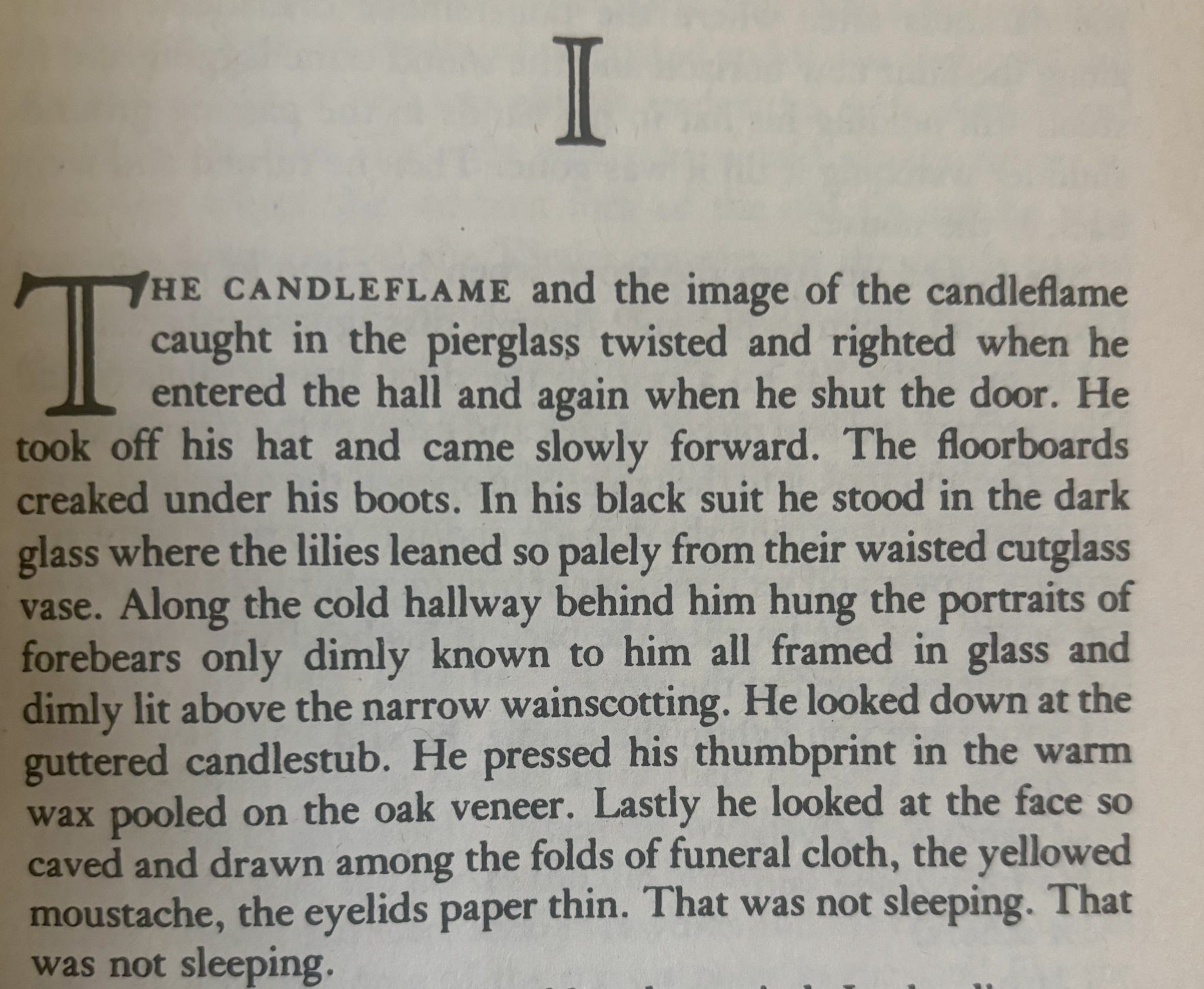
“That was not sleeping.” All the Pretty Horses begins with a burial and ends with another. In between, a boy crosses into Mexico and returns having learnt that heroism mostly works in fiction. This is McCarthy's version of the classical hero’s journey and coming-of-age arc.
Cormac McCarthy’s Border Trilogy includes these three novels:
All the Pretty Horses (1992)
The Crossing (1994)
Cities of the Plain (1998)
(The name “The Border Trilogy” isn’t a retroactive nickname. It came from McCarthy himself and was supported by his publisher Alfred A. Knopf.)
The border is of course the US–Mexico border, southwest Texas in ATPH and New Mexico in the two other books. ATPH is the story of 16-year-old John Grady Cole, The Crossing is the story of another 16-year-old, Billy Parham. After these two stories, John Grady and Billy are brought together as the two main protagonists of COTP. The stories are otherwise independent and without others character in common. You don’t need to read the first two books before reading the last, but COTP gains much from knowing the two men’s backstories.
These are relatively straightforward stories, by McCarthy’s standards; a common pattern is love or attachment then disillusion and death. Uncommon for McCarthy are the romances central to the plots of ATPH and COTP where an American cowboy falls for a Mexican woman—archetypically pure and depraved, respectively. The Crossing is romance-free and instead more about brotherly love and attachment for a she-wolf. It has way more symbolism and mysticism and is the most ambitious of the three.
The writing style is a clear departure from his previous books. It’s not as oppressive and solemn as Blood Meridian, and not as dense and detailed as Suttree. McCarthy feels more confident in his lyricism, storytelling, and his characters. With the exception of Suttree, it’s the first McCarthy book with real character interiority. These changes make the Border Trilogy much more approachable and contributed to the popular success of ATPH, after a National Book Award that turned McCarthy from a cult novelist into a public literary figure.
The trilogy has been described as an elegy for the American western cowboy lifestyle—horsemanship, brotherhood, honor, restraint—and I agree with that. A more contemporary temptation I’ve noticed is to see a statement about the failure of masculinity. That feels too narrow and self-serving, for McCarthy isn’t doing that. Instead, he gives the cowboy world its beauty and places in its harsh historical context and physical environment to salvage its dignity rather than to condemn it.
The Border Trilogy is more broadly an ode to the end of a certain West, with cowboys on horseback and older forms of violence. McCarthy doesn’t romanticize young Americans riding south and crossing the border in search of a new frontier or of some authenticity that postwar America would lack. Nor does he treat the US–Mexico border as a contemporary political question, though it’s always been one. In his books, violence and conflict are older and more continuous than politics. The cartel brutality of No Country for Old Men and The Counselor is not depicted as morally worse or better than the violence of Blood Meridian; it is another historical form of the same human darkness.
Chronology note
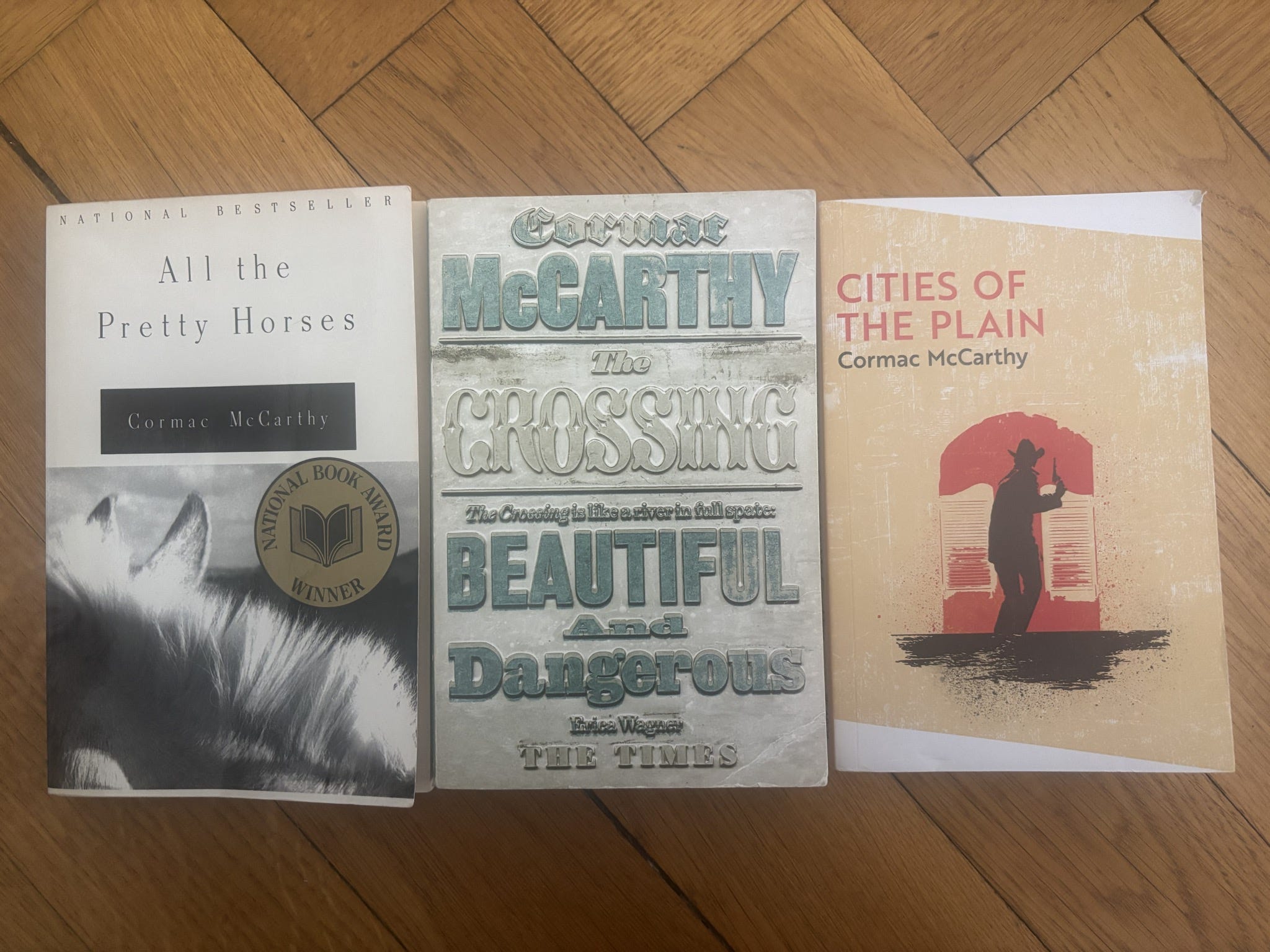
I bought my copy of ATPH in a small bookshop in a small Arizona town in 2010 and I read it during travels in the Southwest. It’s the first Vintage International edition from 1993, a nice object in itself.
I only read The Crossing in 2022, in that Picador edition with a terrible cover where the word “beautiful” is more prominent than the title and McCarthy’s name. Not sure what they were thinking.
COTP is the McCarthy novel I read last, as late as 2024, in the newest 2022 Picador edition with its minimalist cover. By then I had already read McCarthy’s final novels, The Passenger and Stella Maris. As I started working on this post, I realized I had more vivid memories of The Crossing than of COTP, except for its last chapter and epilogue, the final sixty pages of the book.
Disclaimer and credits
To avoid spoiling too much of the stories I’ll try to focus on events happening in the first half of the books. But it won’t be totally spoiler-free.
I borrowed some observations from the articles in Perspectives About Cormac McCarthy, namely
All the Pretty Horses: John Grady Cole’s Expulsion from Paradise, by Gail Moore Morrison.
The Road and the Matrix: The World as a Tale in The Crossing, by Dianne C. Luce.
The Last of the Trilogy: First Thoughts on Cities of the Plain, by Edwin T. Arnold.
All the Pretty Horses
All the Pretty Horses opens on September 13, 1949, almost exactly a century after Blood Meridian’s events. It looks like a very conventional Bildungsroman, beginning with John Grady being rejected by his mother and girlfriend then riding South with a friend. Then they meet Jimmy Blevins, the boy who’ll be a sidekick and disruptor. You understand very early on that he’s trouble.
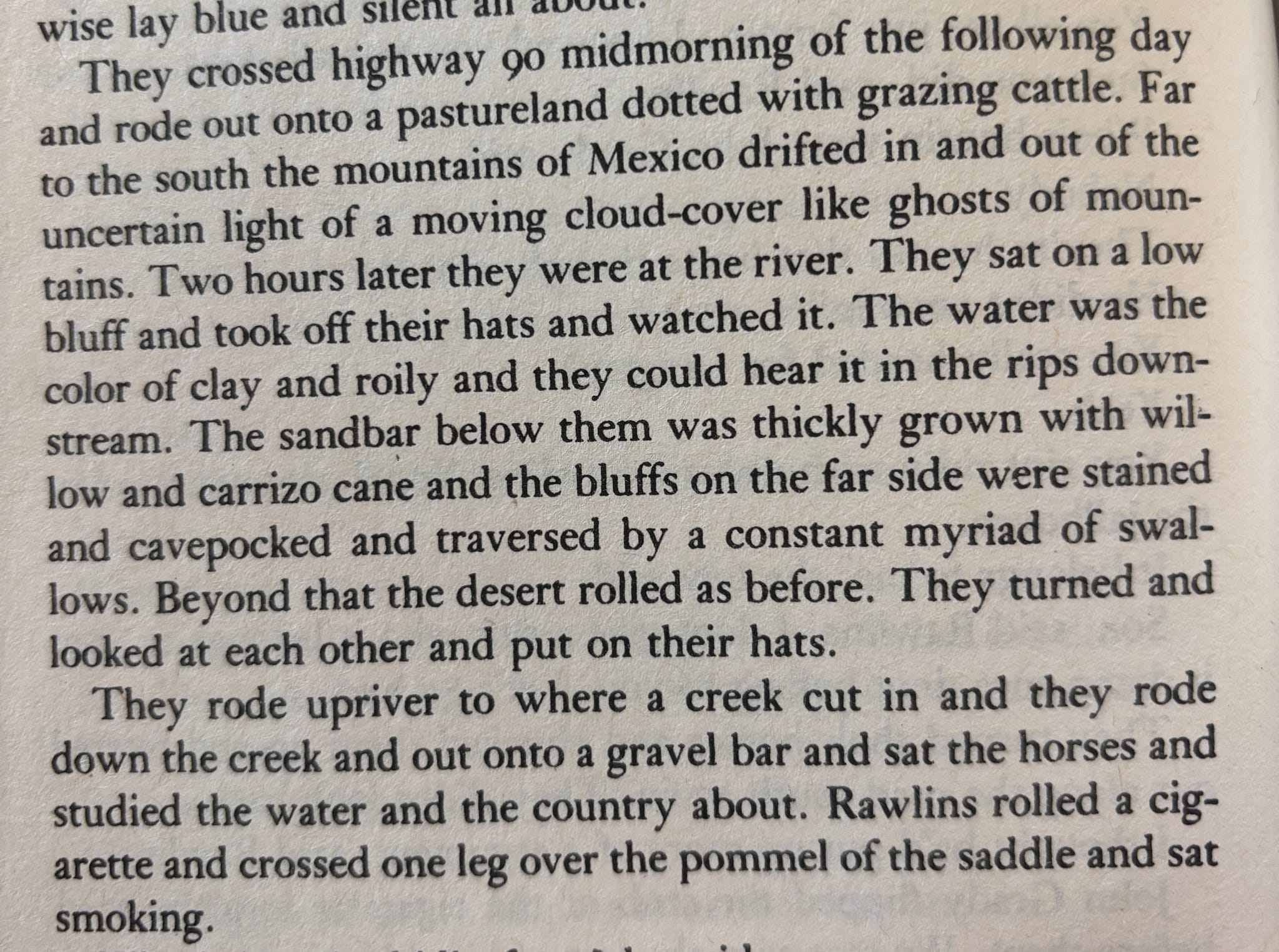
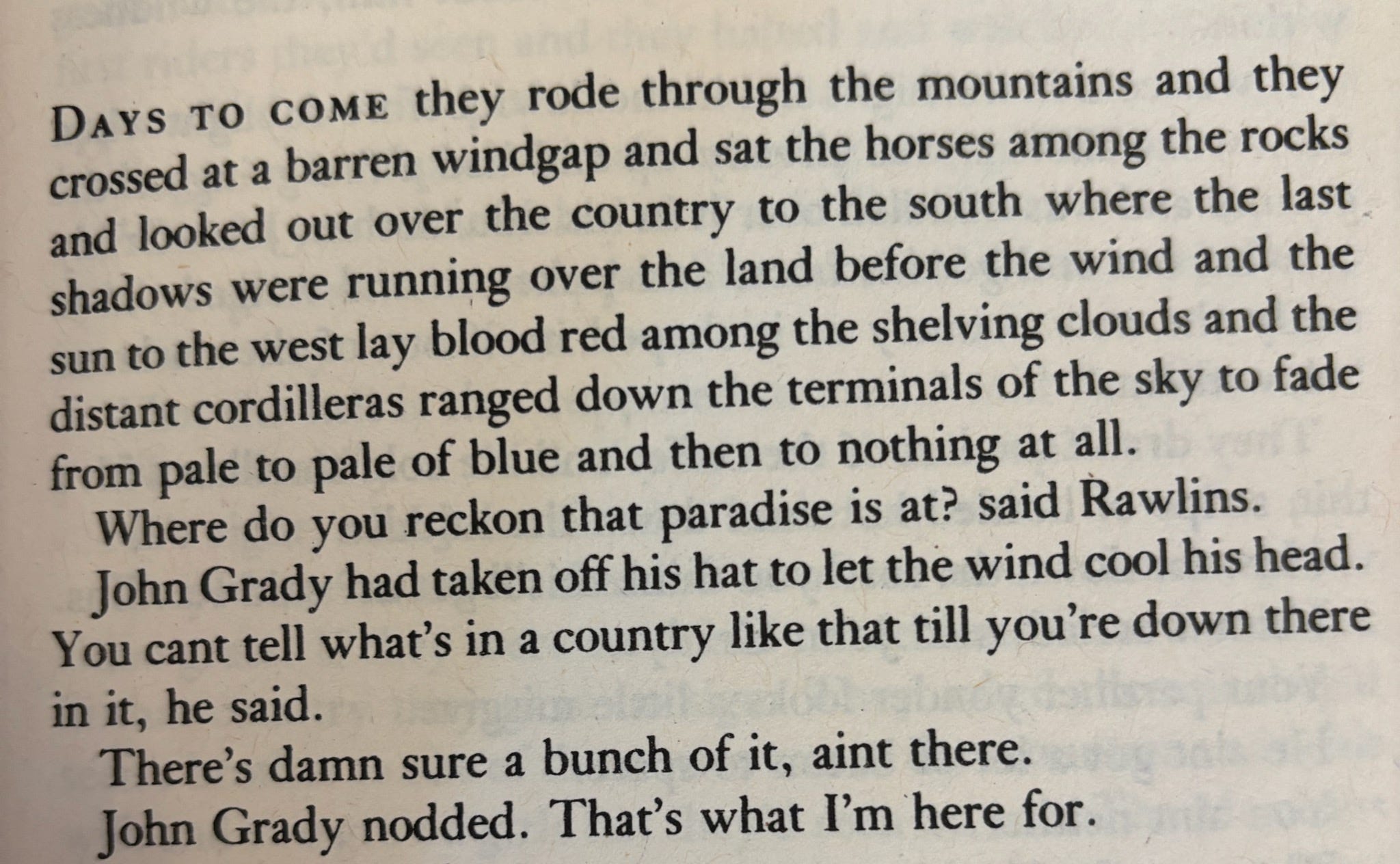
As in Blood Meridian, the landscape is as much a character as the human protagonists. John Grady Cole and Lacey Rawlins leave from near San Angelo, Texas and reach a ranch in the Mexican state of Coahuila near Cuatro Ciénegas, which today is about 380 miles by road. In the excerpts below you’ll note “the sun to the west lay blood red”:
John Grady and Lacey find work as ranch hands at la Hacienda de Nuestra Señora de la Purísima Concepción. As Gail Moore Morrison notes in her essay, this name is an “ironic double entendre” for a place where the owner, Don Hector Rocha, “has conceived a breeding strategy to produce a superior cutting horse by crossing his quarter horse mares with a thoroughbred stallion.” Morrison later hilariously writes that
John Grady is, of course, banished from the hacienda because Señor Rocha is not interested in a similar experiment in crossbreeding between his daughter Alejandra and the Texas import.
Alejandra is McCarthy’s Juliet: the impossible beloved, the daughter of a local aristocracy. She has a reputation and a family line to maintain, which her aunt tries to explain to her, the same aunt who will intercede in John Grady’s favor. John Grady first sees her riding her black Arabian mare:
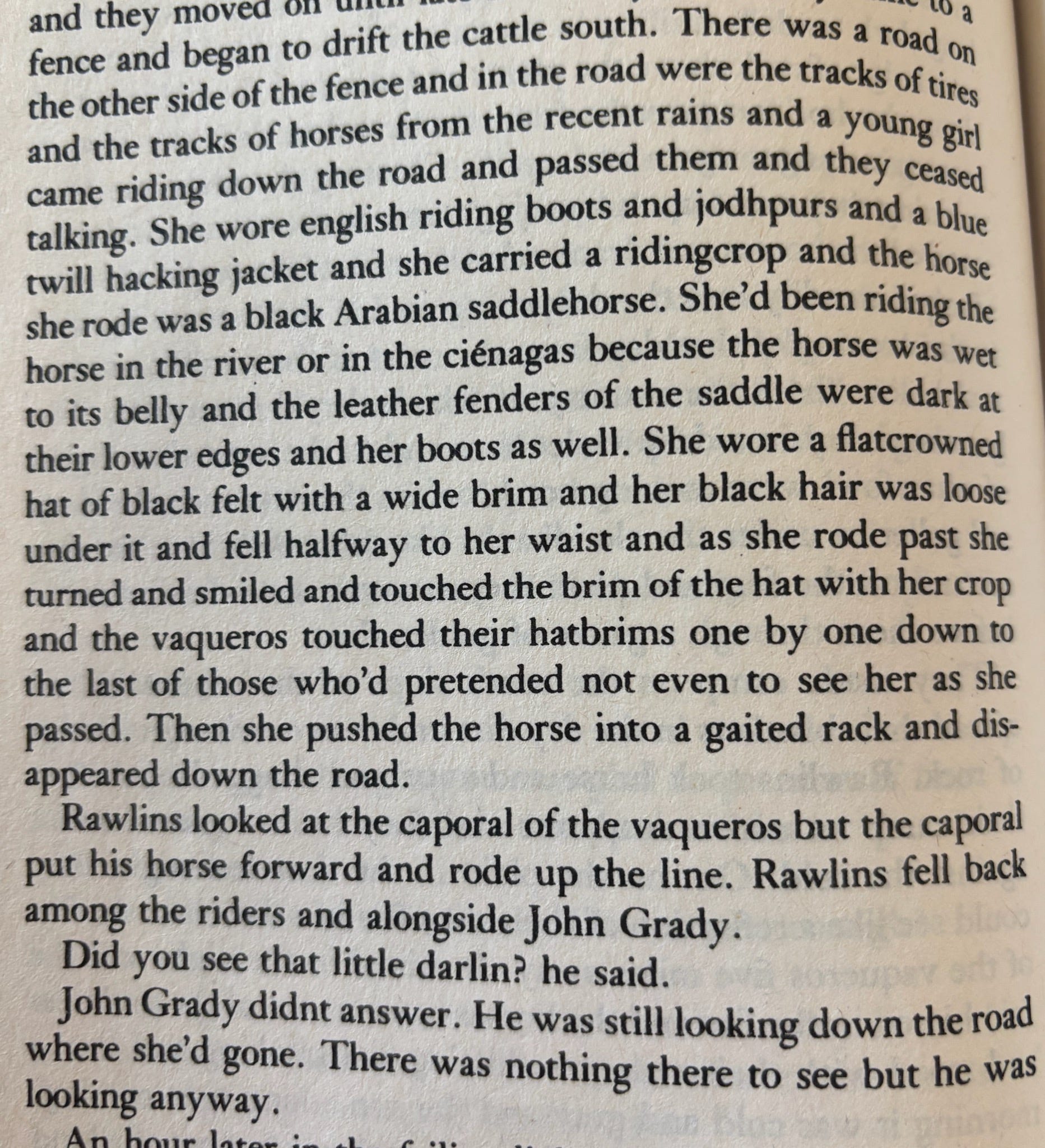
You know what’s going to happen; they’ll fall in love but the relationship will be doomed; John Grady and Lacey will get in trouble (thank you Blevins), and Alejandra won’t marry John Grady. Despite all his heroic traits (horseriding, physical strength, chess skills, etc.) he won’t show the efficacy of a hero and won’t save the princess—quite the other way around. Like I said I’d like to avoid too many spoilers so I won’t tell much more.
I can’t not mention the 2000 film, directed by Billy Bob Thornton and starring Matt Damon and Penelope Cruz. I haven’t watched the whole thing, but I saw the trailer and a few scenes. It seems earnest and fairly faithful to the book, and Jimmy Blevins is well cast, close to how I imagined him. But in my opinion, John Grady and Lacey look way too clean and angelic compared to the book, and the love story badly suffers from the casting: Damon and Cruz were 28 and 25 but played 16-year-olds, whose youth and sexual innocence are essential to the story. The film therefore lacks the romanticism of that first love. And ironically, Blevins is played by a 16-year-old actor, though the character is 13 and pretending to be 16.
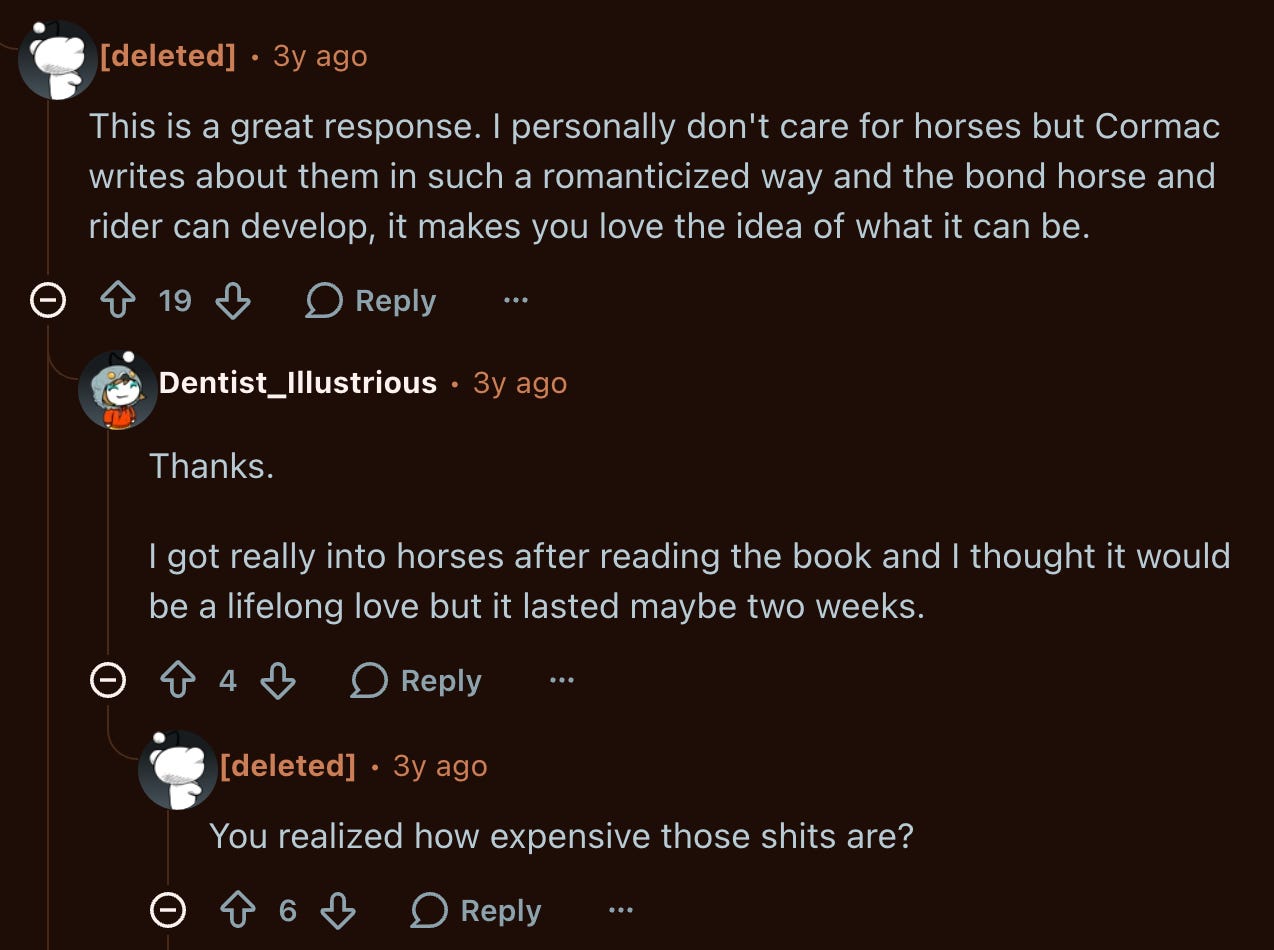
To conclude on something funnier: loving Reddit about ATPH:
The Crossing
The Crossing isn’t as famous as ATPH, but it’s the most ambitious of the three novels, and also my favorite. It’s the one I remember most vividly and the one I now want to finish rereading as I work on this post. Billy and Boyd Parham may not have John Grady Cole’s outward charisma, but The Crossing reaches depths the other two books don’t. I find it more poetic, more understated, and the strongest of the trilogy. But the tagline of this blog applies: “This is just my opinion, I am sure yours is completely different.”
In the late 1930s, brothers Billy and Boyd Parham (16 and 14) live with their parents on an isolated cattle ranch in the Animas Valley in Hidalgo County in southwest New Mexico. A wolf was spotted attacking cattle. They set traps to catch the wolf. They end up catching her (a pregnant she-wolf) but then Billy feels a spiritual connection—for lack of better words—with the wolf and chooses not to kill her. Instead, he decides to take her back to her (allegedly) home in Mexico.
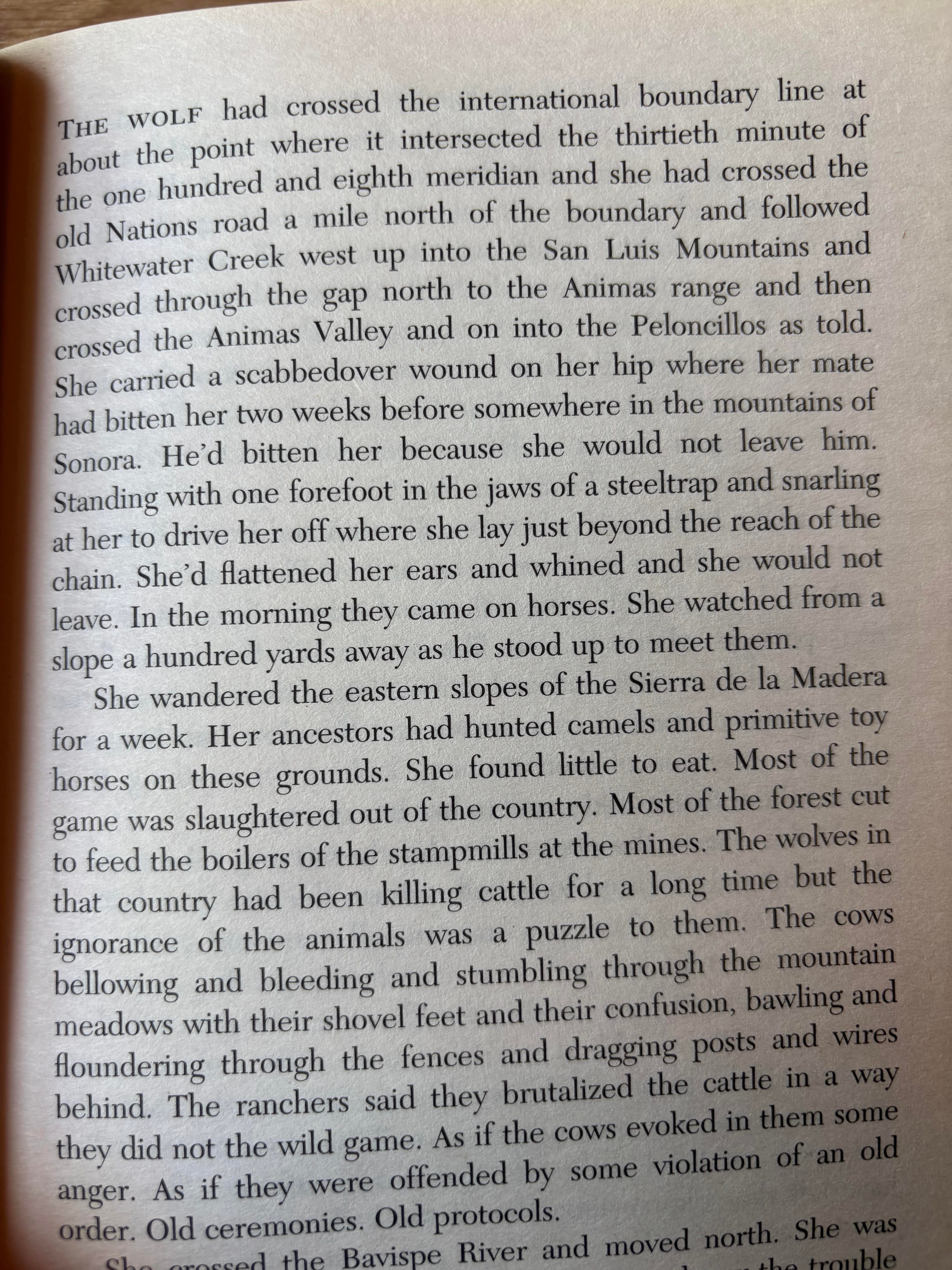
The wolf isn’t just an animal but a genuine character. The NYT review even writes that “none of the women in these novels are particularly believable—the most complex and sympathetic female character in the trilogy may be a wolf.” See for example these lines:
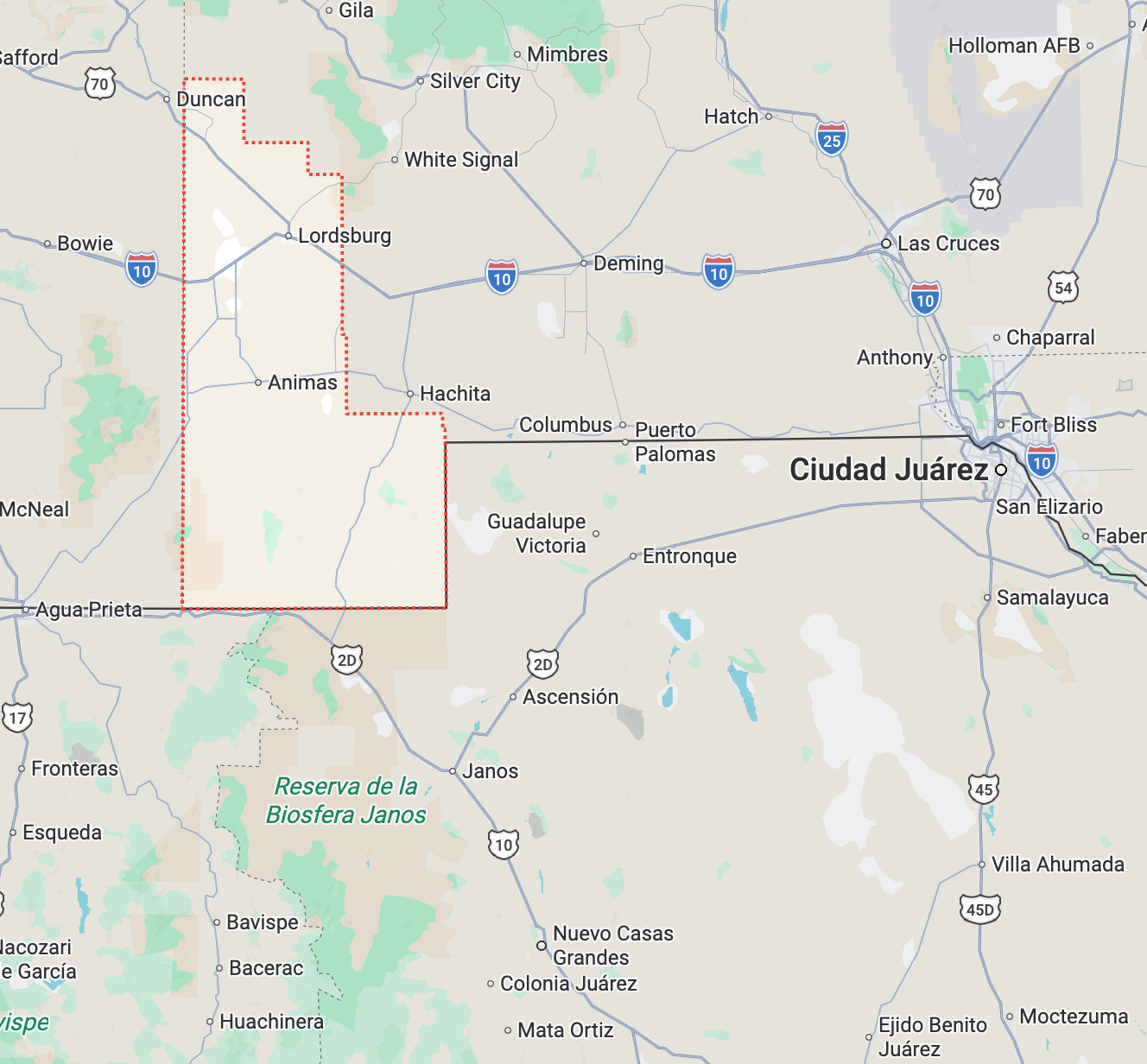
A little geographic context: the red-bordered area on the map below is Hidalgo County. The thick black line is the US–Mexico border, and the vertical dotted line is the Sonora–Chihuahua border. Billy and Boyd travel through both Mexican states, and the book mentions in particular the Sonora towns of Bavispe and Bacerac that you see at the bottom-left.
Even more than ATPH, The Crossing is a road narrative, roughly structured as three crossings for the US–Mexican border (in this direction, so technically there are six border crossings), with several disjointed subplots. To avoid revealing too much of the story, I’ll just say that the first crossing is about a wolf, the second is about horses (whereas in ATPH, Blevins’ stolen bay horse is one of the causes of the heros’ troubles, here Billy and Boyd’s second crossing into Mexico is related to stolen horses), and the third is even more sinister than the second and is about a man’s remains. These journeys span several years and the book finishes around the time when WWII begins.
ATPH is not exactly a happy story, but The Crossing is even more melancholic. Hope and life are hidden in its philosophical passages, encounters and tales from the many picaresque characters that Billy and Boyd meet on their journey: Indians, Mormons, gypsies, fortunetellers, opera singers, blind men, bandits, Mexican peasants and villagers, etc.
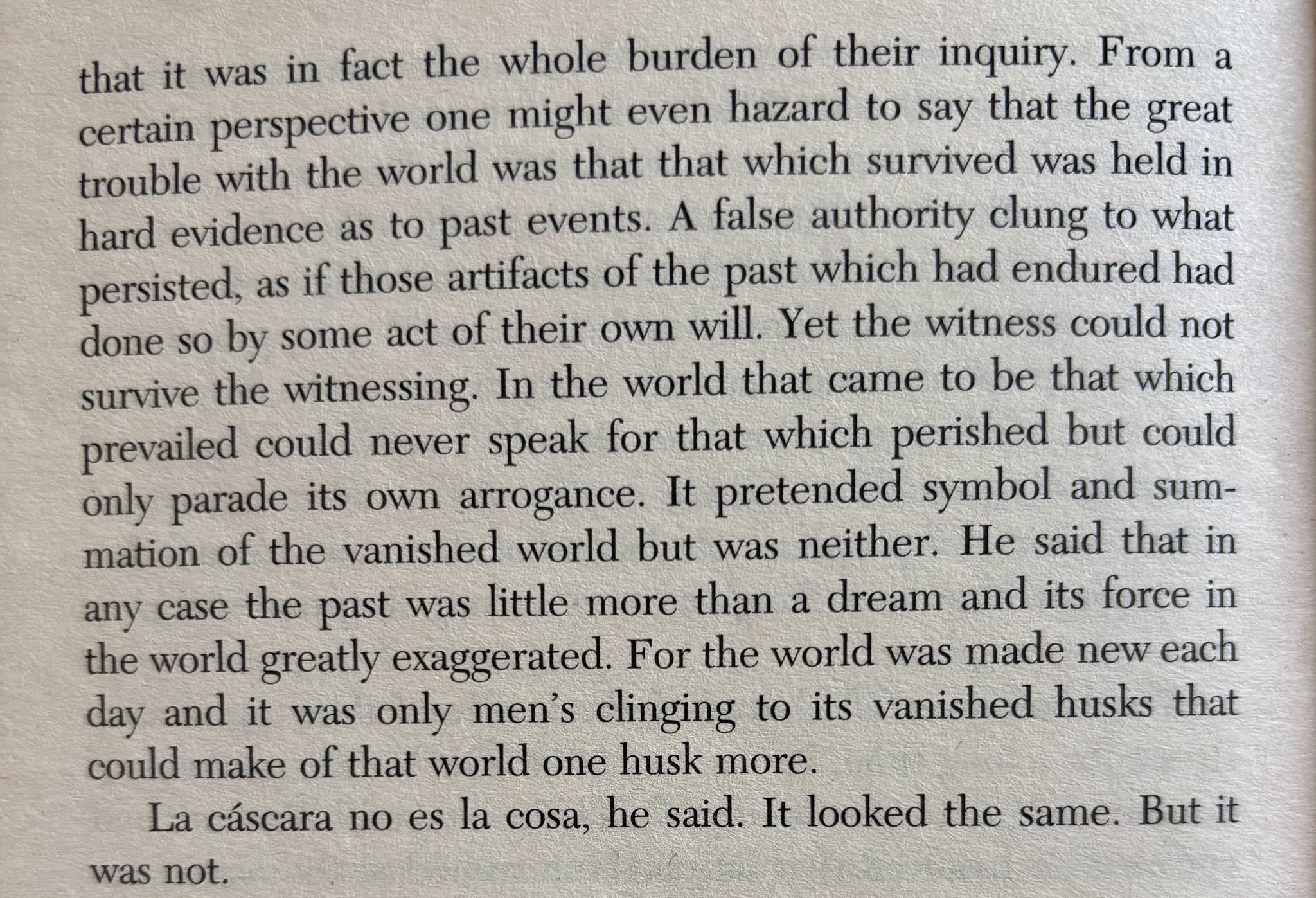
Let me conclude with this excerpt from the gypsy man’s story, near the end of the book. The gypsy tells Billy a story about salvage workers trying to determine the “true” identity of a crashed canvas biplane when a second identical one is discovered ruined in the mountains, in an allegory of Billy’s life (and, probably unintentionally, reminiscent of McCarthy's penultimate novel The Passenger, whose main character is a salvage diver investigating an elusive plane crash):
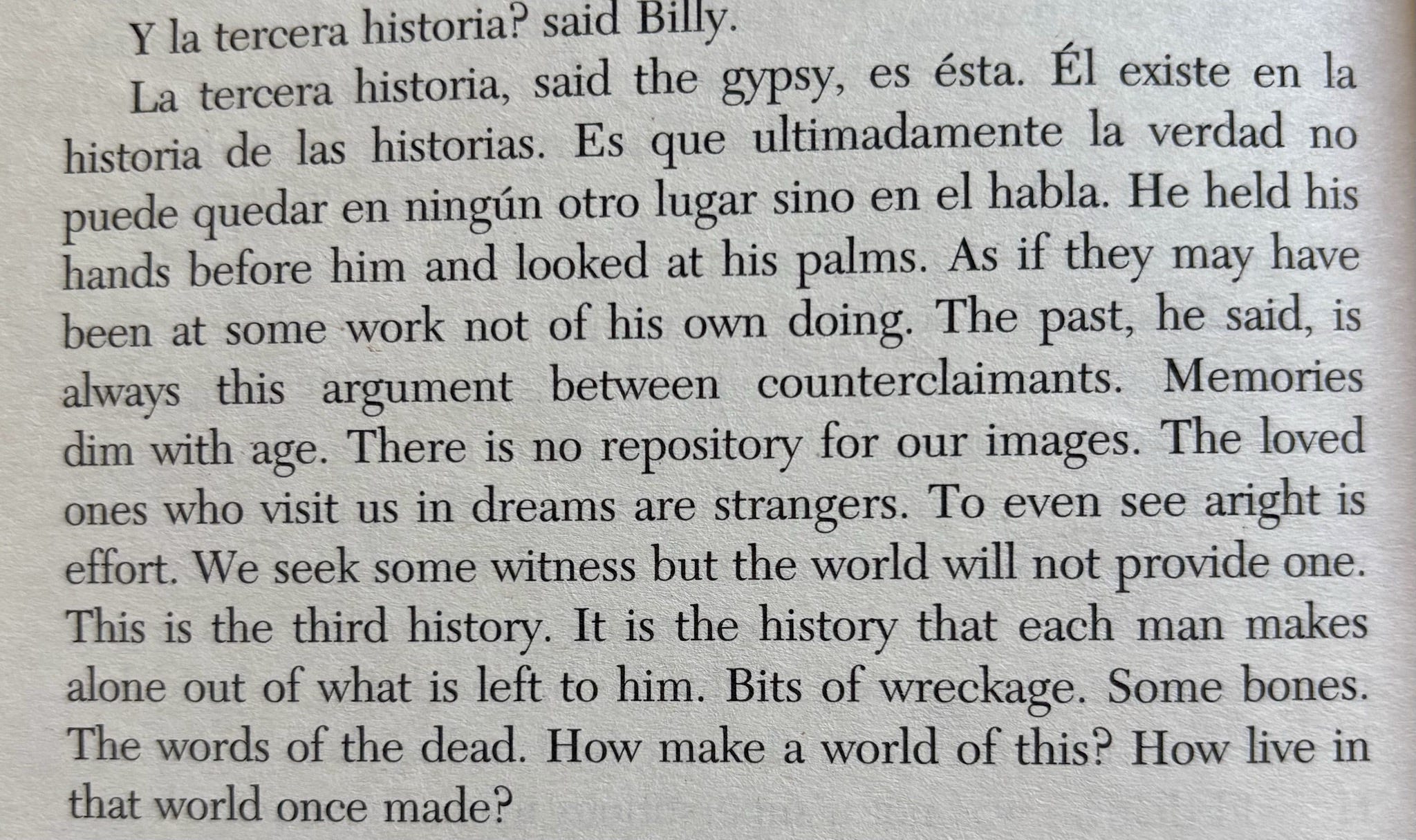
The gypsy splits his story into three parts, where the first is what allegedly really happened to the plane, the second is someone’s perspective/speculation, and the third is the ‘meta’ story, as we’d say today:
Cities of the Plain
McCarthy first wrote COTP as a standalone screenplay in 1984. When the film didn’t get made, he decided to write the backstories of the two main characters. Edwin T. Arnold’s article in Perspectives discusses the differences between the screenplay and the published novel.
The book’s cinematic origin is easy to feel; it’s shorter and more dialogue-driven than the first two volumes and many scenes already seem half-staged: cowboys talking in bunkhouses, men crossing into Juárez, etc. Film director Andrew Dominik later tried to adapt COTP and courted James Franco for the project, but Franco—who tried to bring Blood Meridian to screens—turned it down. I’m not sure a standalone COTP film would be a good idea either. The plot can stand alone but may be too shallow without the characters’ background. Still, with the right actors, some of the dialogue could work on screen:
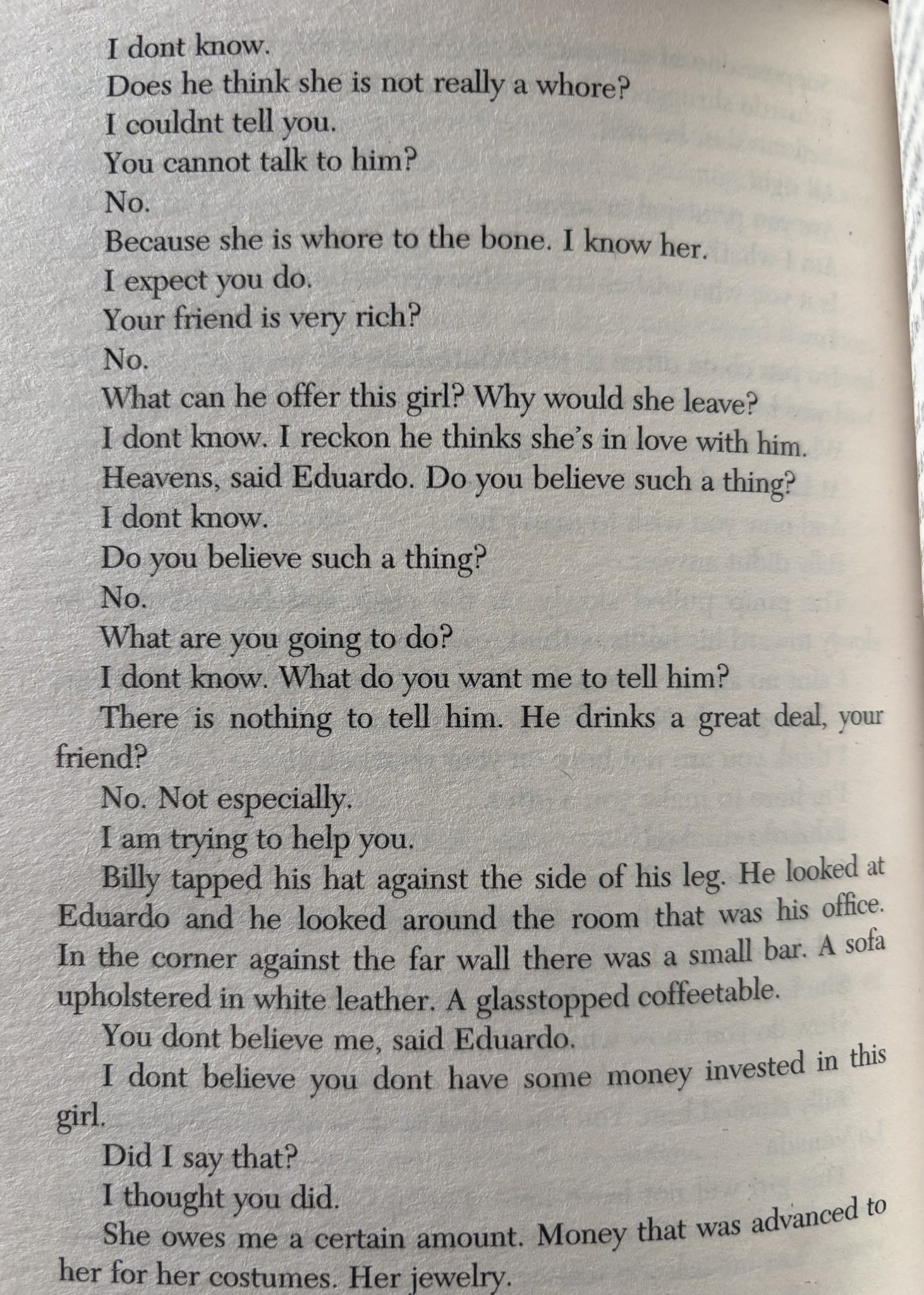
Here Billy is Billy Parham, from The Crossing, and the “friend” that Eduardo mentions is John Grady Cole from ATPH. Both boys are 16 at the start of their respective books (ATPH takes place in the late 1940s while The Crossing does in the late 1930s.) The events of COTP start in 1952, thus John Grady is around 19 and Billy around 28. They work in a ranch north of El Paso, in New Mexico, across Mexico's Ciudad Juárez—which always reminds me of Bolaño's 2666.
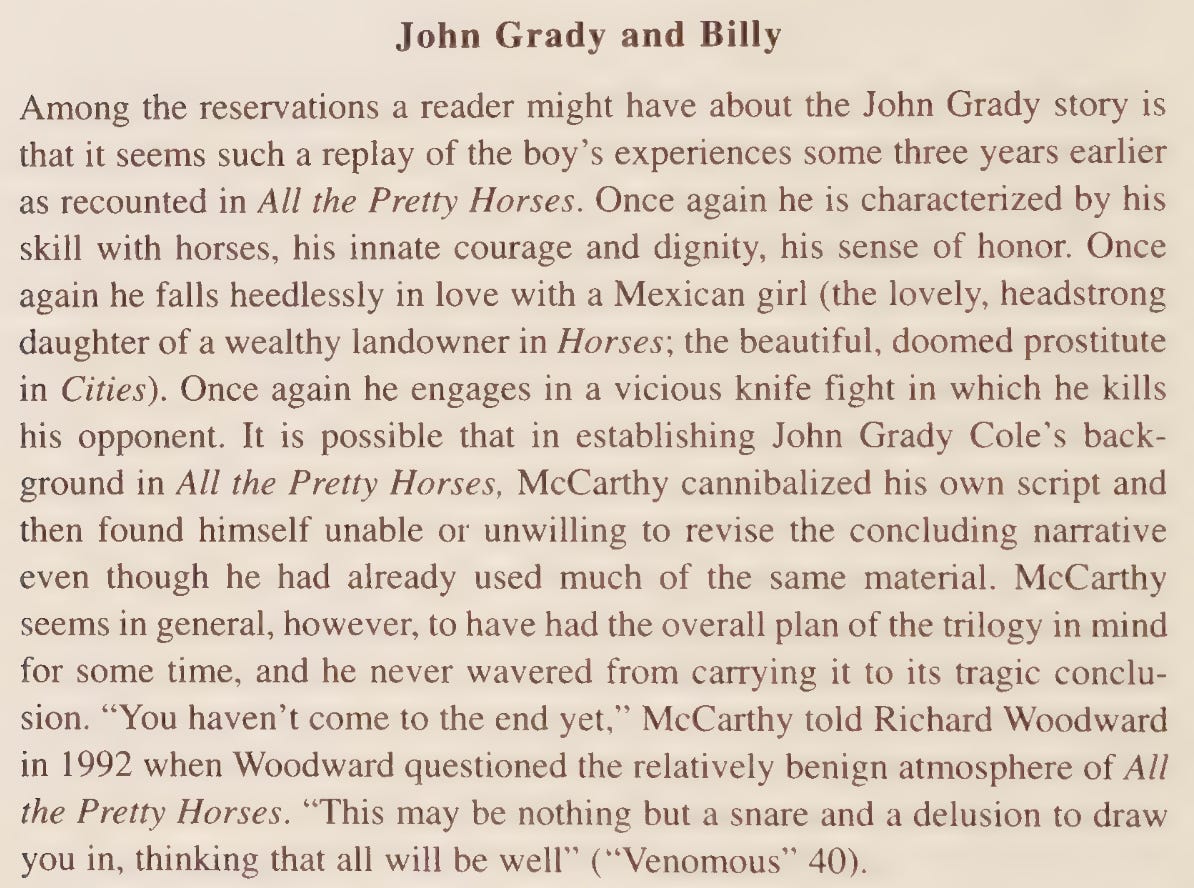
COTP is shorter novel than the first two books of the trilogy, and is often perceived as the weakest of the three. A common criticism is John Grady’s “replay” of a doomed romance, this time with the (fittingly named) prostitute Magdalena, as Arnold comments in his essay:
I think the greatest part of COTP is its last third; the confrontation between John Grady and Eduardo, and even more memorably its epilogue. The final pages provide closure not only to the novel and its characters, but to the trilogy and its reflection on the Western “cowboy life” (again, for lack of a less reductive term), where the protagonist meets a prophetic voice like the preachers of The Crossing:
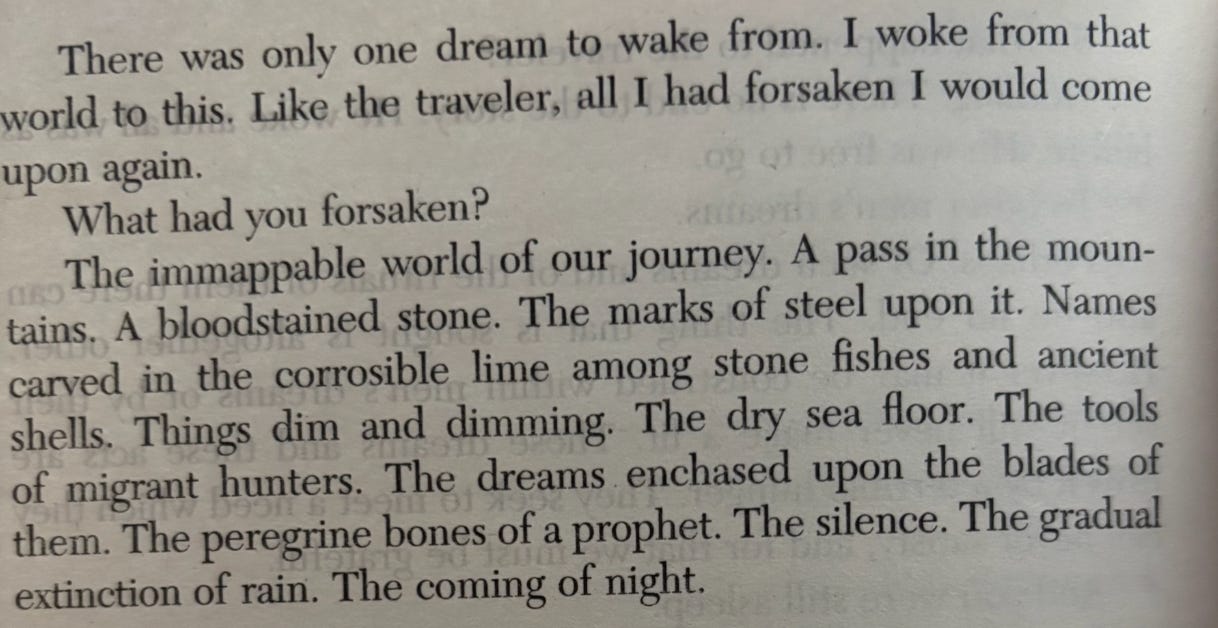
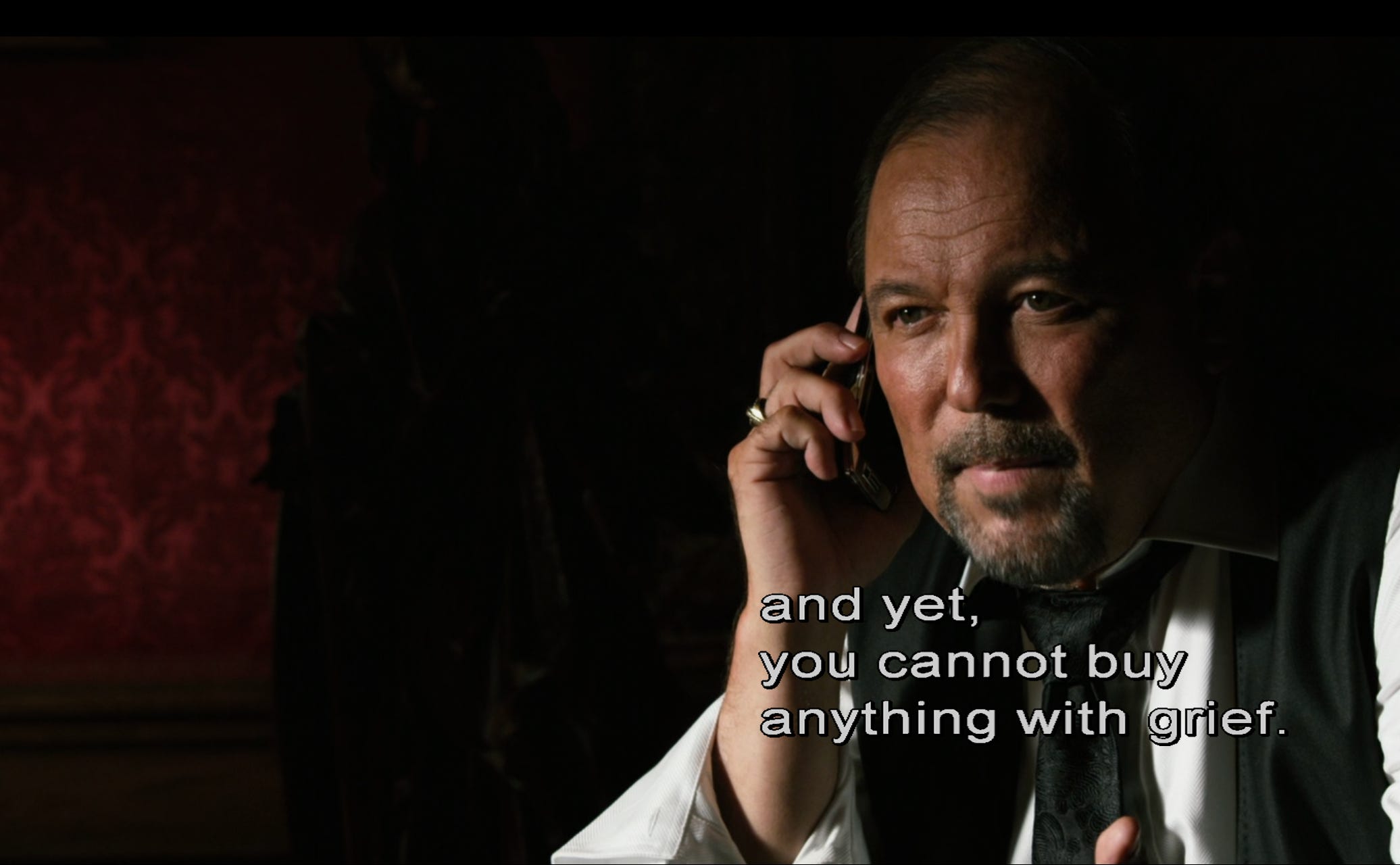
I remember that shortly after reading COTP I watched The Counselor, the not especially memorable Ridley Scott film written by McCarthy with Michael Fassbender, Javier Bardem, Cameron Diaz, and Penelope Cruz. (The Counselor is cinematographically superior to All the Pretty Horses [see below] but not as good as the Coens’ No Country for Old Men, notwithstanding [or because of?] its all-star cast) In The Counselor, the Mexican crime boss bears a philosophical resemblance to his counterpart in COTP (Eduardo, the brothel’s owner) and both appear near the end to lecture the American hero on idealism, violence, and reality. In The Counselor, what the Mexican boss says is very McCarthy and not far from the world of COTP:
– When it comes to grief, the normal rules of exchange do not apply, because grief transcends value. A man would give entire nations to lift grief off his heart, and yet, you cannot buy anything with grief. Because grief is worthless.
– Why are you telling me this?
– Because you continue to deny the reality of the world you’re in.
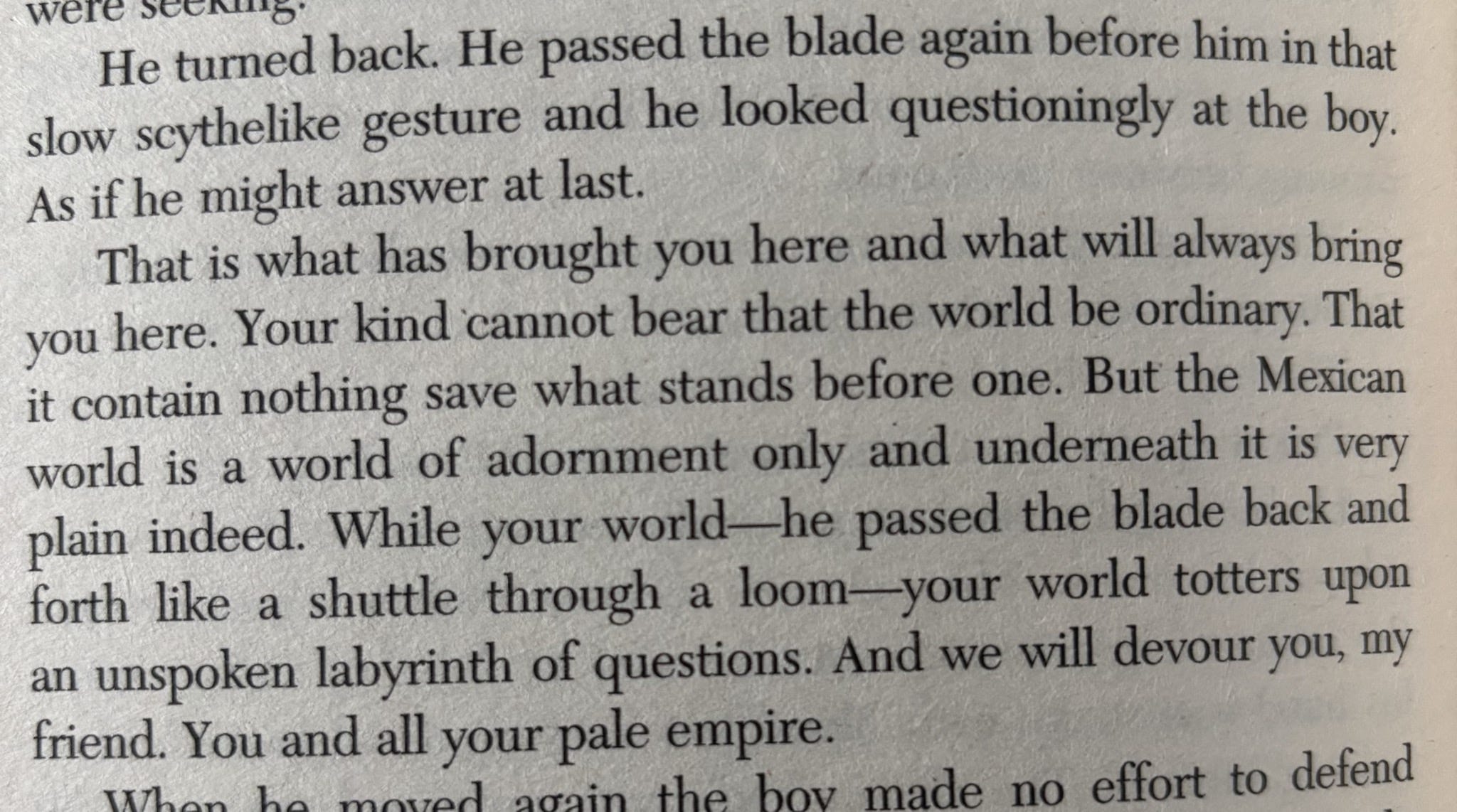
In COTP, when John Grady fights Eduardo in Juárez, the Mexican dispenses similar advice:
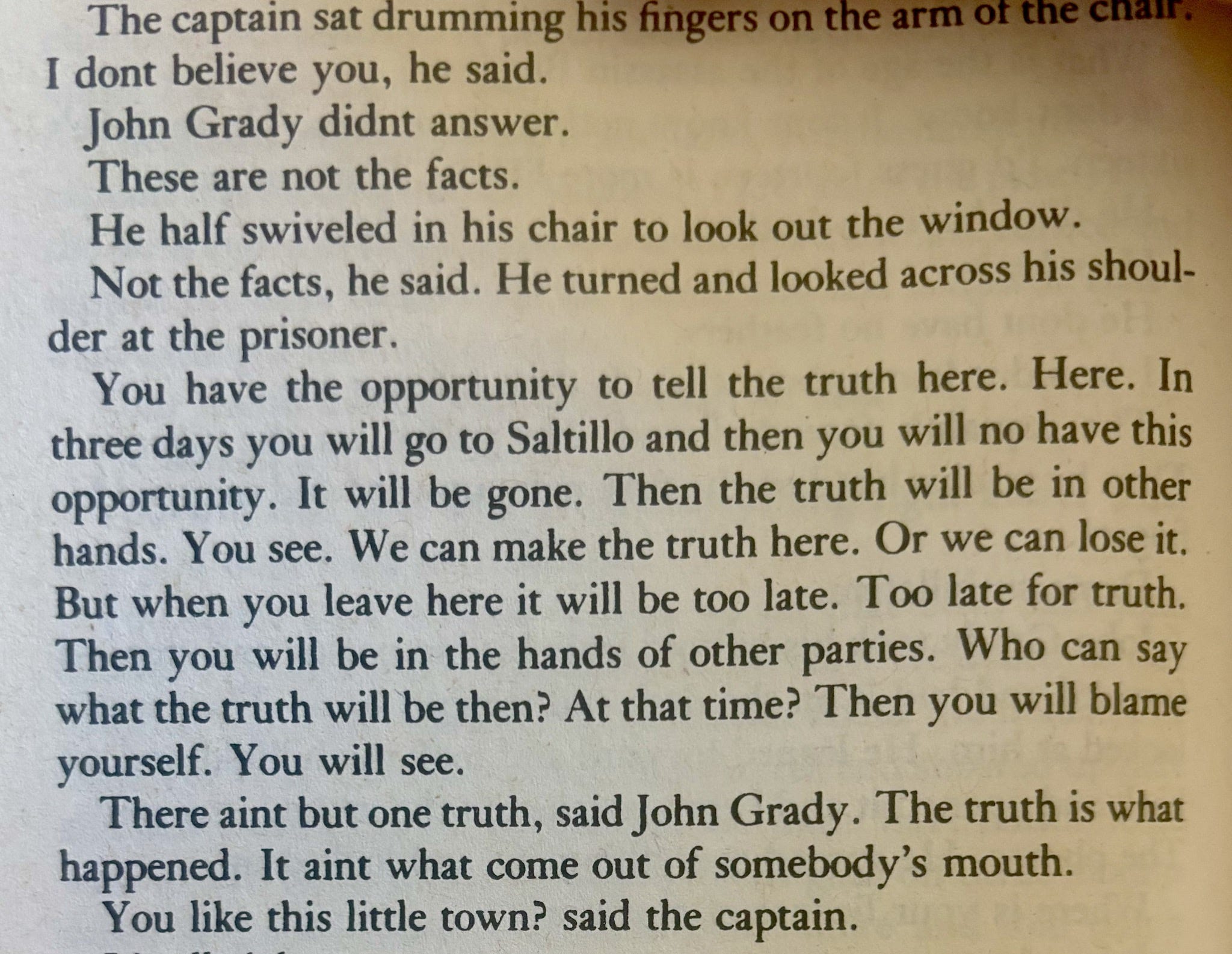
Interestingly, ATPH also has a similar scene, when John Grady is interrogated by the Mexican Captain, though it happens in the first third of the novel rather than its conclusion and is therefore less dramatic. Short excerpt:
Next
I’m now going to finish rereading The Crossing, and after that I’ll turn to McCarthy’s most famous books, No Country for Old Men and The Road.
This is probably the post in the series I most enjoyed writing. Part of that was the pleasure of reopening the books; the first ATPH pages, the late timeless gravity of COTP, and basically anything from The Crossing. It also reminded me that I’ve meant to travel to NM and TX for year. I might finally go later this year.
The Border Trilogy isn’t McCarthy at his most terrifying or his most extreme in any way, quite the contrary. It’s where he’s the closest to a reasonable, popular writer, and perhaps where he’s at his the most sentimental. NCFOM will keep us near the TX-Mexico border, a thriller-like story, a drier and more minimalist prose, and a villain who’s a modern incarnation of Blood Meridian’s Holden. And then The Road, which is in some ways more brutal than Holden and Chigurh combined.